
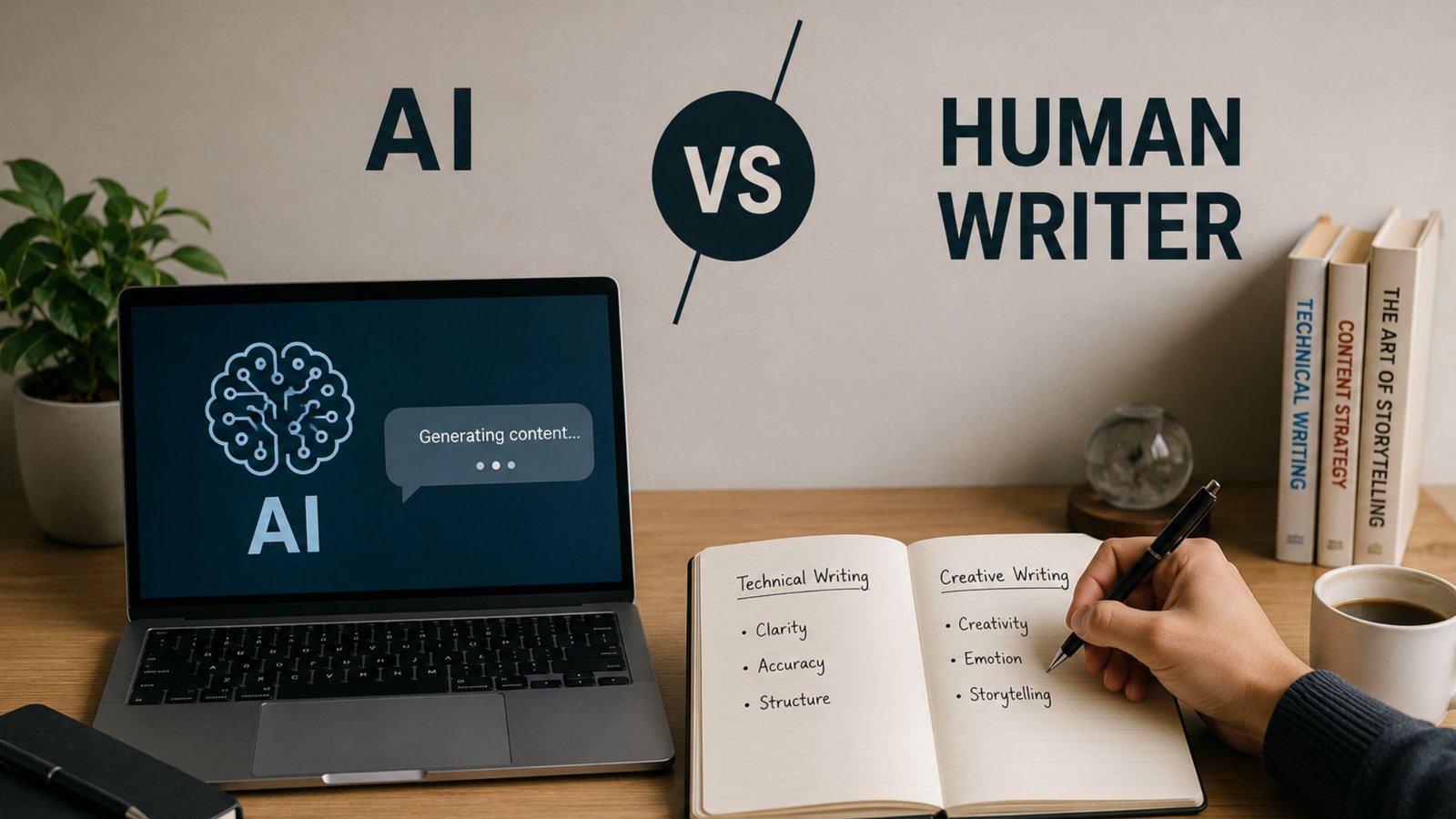
Open any writers’ forum or LinkedIn comment section today, and you will find the same question on repeat: Will AI replace writers? Tools like ChatGPT and Claude can now draft a blog post, summarise a research paper, or even mimic a brand’s tone in seconds. For anyone who writes for a living, that is unsettling to watch.
But the honest answer isn’t a simple yes or no. It depends on what kind of writing you do, how willing you are to evolve, and whether you treat AI as competition or as a tool. Let’s break this down properly – for both technical and creative writers – so you can separate the genuine shifts from the noise.
Will AI Replace Writers? The Short Answer
Right now, AI is changing how writing gets done far more than it is eliminating the need for writers. It can produce a first draft, suggest headlines, or clean up grammar almost instantly. What it still struggles with is judgment – knowing what to say, what to leave out, and how to make a piece of writing feel like it was made for a specific reader.
Most professional writing isn’t just about stringing sentences together. It involves understanding a brand, an audience, a goal, and often a fair amount of research and strategy. AI can support all of that, but it rarely originates it on its own with the kind of accuracy and nuance a skilled writer brings.
Will Writers Be Replaced by AI, or Will They Adapt?
This is really the more useful question to ask. History has a habit of repeating itself here – word processors didn’t replace writers, the internet didn’t replace writers, and content management systems didn’t either. Each shift changed the job, not the need for the person doing it.
Writers who treat AI purely as a threat tend to fall behind. Writers who learn to use it well – for research, outlining, repurposing content, or speeding up first drafts – end up producing more work, faster, without losing quality. The people at risk aren’t writers in general; it’s writers who refuse to update how they work.
Will AI Replace Technical Writers?
Technical writing has a reputation for being more “formula-driven” than creative work, which is exactly why this question comes up so often. Documentation, manuals, SOPs, and API guides do follow patterns, and AI is genuinely useful for drafting boilerplate sections or restructuring dense information.
But technical writing is rarely just about formatting information neatly. It demands:
- Deep understanding of how a product or system actually works, often gained by testing it directly
- The ability to spot gaps, outdated steps, or inconsistencies a tool has no way of knowing exist
- Judgment on what a reader genuinely needs to know versus what’s just noise
- Accuracy that can’t be guessed — a wrong step in a technical guide can break something for the end user
AI can speed up the writing process for technical writers, but it cannot independently verify a process, test a feature, or understand internal context that lives in a company’s tools and teams. That’s precisely why technical writers who learn to use AI for drafting, while staying responsible for accuracy and structure, remain firmly in demand.
Will AI Replace Creative Writers?
Creative writing is where this debate gets the most emotional, and understandably so. Stories, scripts, brand campaigns, and poetry are deeply tied to lived experience, originality, and emotional intelligence — areas where AI is, at best, working off patterns it has seen before rather than something it has actually felt.
AI-generated creative content tends to read as competent but generic. It can mimic a style once it has examples to draw from, but it cannot:
- Draw from genuine personal experience or emotion
- Make a deliberately unconventional creative choice and explain why it works
- Build a consistent voice that evolves naturally across a body of work
- Understand cultural context and humour with real precision
This doesn’t mean AI has no place in creative work. Many writers already use it to brainstorm angles, beat writer’s block, or test multiple openings for a piece. But the final voice, the emotional pull, and the creative risk-taking still come from the human holding the pen.
What AI Is Actually Good At (and Where It Falls Short)
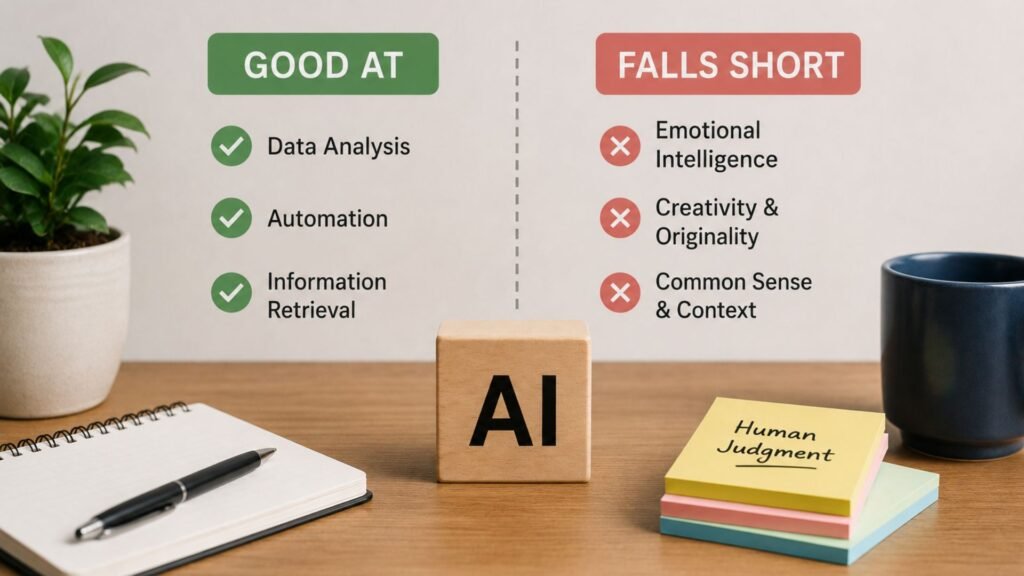
It helps to be specific instead of treating “AI” as one giant, vague threat. Here’s a more honest breakdown:
AI tends to be strong at:
- Speeding up first drafts and outlines
- Summarising long documents or research
- Suggesting alternate phrasing or fixing grammar
- Repurposing one piece of content into multiple formats
AI tends to struggle with:
- Original ideas rooted in real experience or insight
- Maintaining nuance, tone, and brand voice consistently
- Verifying facts or technical accuracy independently
- Understanding context that isn’t explicitly written down
Seen this way, the technology looks less like a replacement and more like a very fast, occasionally clueless intern — useful, but not somebody you’d let make the final call.
Skills Writers Need to Stay Irreplaceable in the AI Era
A few skills are quickly becoming what separates writers who thrive from writers who feel threatened:
- Editing and judgment — knowing what to keep, cut, or rewrite from an AI-assisted draft.
- Subject-matter depth — especially for technical writers, since real understanding can’t be faked or generated.
- Voice and storytelling — the ability to write something that sounds unmistakably like a person, not a template.
- Prompting and AI literacy — getting useful output from AI tools is itself becoming a writing skill.
- Strategic thinking — understanding why a piece of content exists and what it needs to achieve, not just how it reads.
Writers who genuinely understand how to write engaging content — content that holds attention and earns trust, rather than just filling space — are the ones AI struggles to replace, because that skill comes from understanding people, not patterns. If you want a deeper look at what actually makes content compelling, our guide on how to write content that keeps readers engaged is worth a read.
How to Adapt: Becoming an AI-Augmented Writer
If you write for a living, here is a practical way to stay ahead instead of being anxious:
- Use AI for the first 20%, not the last 80%. Let it help with structure or a rough draft, then put in the real craft yourself.
- Specialize. General-purpose writing is the easiest to automate. Deep expertise in a niche, industry, or technical domain is not.
- Learn to prompt well. Treat it like briefing a junior writer — the clearer your input, the better the output.
- Fact-check everything. AI tools can sound confident while being wrong, especially with technical details or statistics.
- Keep building a distinct voice. The more recognisable your writing style, the harder it is for a generic tool to compete with you.
Final Thoughts
So, would AI replace writers entirely? Based on where the technology stands today, that looks unlikely — what’s far more likely is a shift in what writers spend their time on. Less time on blank-page drafting, more time on strategy, accuracy, voice, and the judgment calls that make content actually work.
If you are a business trying to navigate this shift — figuring out where AI fits into your content process without losing quality or authenticity — that is exactly where an experienced partner helps. As a trusted content marketing agency in India, we help brands combine the speed of AI tools with real human strategy, editing, and storytelling, so the content you publish still sounds like it was written for people, not generated for a quota.
Frequently Asked Questions
Will AI replace creative writers like novelists or copywriters?
AI can assist with brainstorming or drafts, but it struggles to replicate genuine voice, emotion, and original creative risk-taking. Creative writing still relies heavily on human experience.
What skills should writers focus on to stay relevant?
Strong editing judgment, subject-matter depth, a distinct voice, and basic AI literacy are becoming the most valuable skills for writers working alongside AI tools.
Can AI write better content than human writers?
AI can write faster and cover the basics well, but it tends to produce generic content without real strategy or emotional nuance. Quality, trustworthy content still needs human oversight.